Showing posts with label ACCT Canada. Show all posts

06 December 2012

Innovation, Partnerships, Productivity

The ACCT Canada conference Innovation Partnerships 2012 was held this week in Ottawa, and featured  excellent discussion on fixing Canada's lagging innovation and R&D productivity record and how innovation intermediaries can do more to foster and enhance Canadian R&D competitiveness.

I convened a panel on P3RD, on which the panelists provided some excellent discussion not only on what works in linking industry and academic R&D partnerships, but how best to measure performance over time. More on this in a minute. The P3RD panel members were as follows:
  • Drew de Kergommeaux, Director, Industrial Research Assistance Program, National Research Council Canada 
  • John Fielding, Regional Director, Business Development, Ontario Centres of Excellence 
  • Marc Nantel, Associate Vice-President - Research & Innovation, Niagara College 
  • Bert van den Berg, Director, Knowledge & Technology Transfer, Natural Sciences and Engineering Research Council of Canada
The issues the panelists discussed focused on how R&D funding programs encourage public-private partnerships, wherein academic and industry work together toward innovation outcomes. The packed audience heard about NRC IRAP's planned concierge service, OCE's funding programs, examples from Niagara College's leading work on college applied research, and some notes on how best to manage performance from Bert van den Berg. The presentation file is online here.

Measuring performance is important for the community in order to adequately and effectively assess what works and what does not. Since we are stewards of public investments in increasing industry innovation capacity, we need to make sure that these investments have a return on innovation, so to speak. As such, it is important to measure the effectiveness of the many actors in the system: the funders, the innovation intermediaries, the faculty and students  and the firms we are serving with industry academic partnership program support. Key here is a logic model approach to understanding all of these actors, the inputs and outputs, and importantly the outcomes of these investments. Bert van den Berg articulated these as impacts:
  • Ultimate: economic & social benefits for citizens 
  • Intermediate: increased sales, profit, employment at firms 
  • Immediate: increased R&D, commercialization, innovation focus by firms, training of HQSP 
These are interesting to note as they are proxies in a way for the work that academic innovation intermediaries do. Our value proposition is that we give industry access to talent, facilities, markets and funding. There are two primary benefits here: students gain crucial innovation literacy skills, and firms get assistance with innovation and market entry for new products and services. Thus a good way to measure the success of George Brown College's support of industry innovation (and by extension any intermediary providing this innovation support) is through the downstream effects we have on the companies we help. This is not to say that we do not measure our own performance, but rather to see our performance and its effect through the main proxy we are here to help: students and industry. To put another way, if we do our job well, we are in the background of greater industry innovation and productivity.

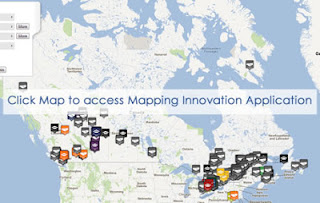
At the P3RD panel we also launched the P3RD site and the mapping innovation application we have developed to assist firms in finding an academic innovation provider. Under the tagline of Putting the S&T in Start Up, the P3RD site lets firms  indicate where they are located, what kind of innovation service they are looking for, and what industry they are from. They are then taken to a map which displays providers, partners and past projects. These past projects are an online resume of past work a provider has done, giving firms an idea of the kind of projects the college, polytechnics or university has done before. We are working with Tenet Computer Group on the technology, specifically their GreenRack cloud service, with plans to further leverage their Augmundo augmented reality technology. Read more about Tenet's leading innovative technology here.


We built this as a marketing vehicle for George Brown College, but have included the ability to add any innovation provider as a way to promote the idea of a concierge service. Think of it as LavaLife for creating public-private R&D partnerships. As I mentioned earlier this year, place matters to productivity. We need to encourage innovation in firms and enable these firms to find a provider of choice, be this down the street or across the country. The P3RD application enables this. 

At the conference we demonstrated the map, including an easy to use tablet interface for adding people. Minister of State for Science and Technology the Honourable Gary Goodyear stopped by to review the P3RD Mapping Innovation application, and to learn how this can aid industry in finding an innovation service provider.
Minister of State for Science and Technology the Honourable Gary Goodyear reviews P3RD Mapping Innovation
We will continue to work on refining the P3RD application with our partners. Check back as we continue to develop the site in partnership with others.

The P3RD panelists discussed how enabling technology innovation is relatively straight forward. What is needed most by firms is business expertise. This was reflected in an excellent panel I attended on social innovation convened by SSHRC president Chad Gaffield.  The social sciences and humanities are key to fostering what Dr Gaffield calls people centred innovation. Specialists in human thought and behaviour are key to enabling the innovation economy. The panel discussed concepts related to public-private partnerships, including not for profits, that are working together to bridge academic and industry sectors. Gaffield spoke about promoting "cultures of innovation" and panelists talked about how building partnerships involves having difficult conversations to link academics with firms when the latter needs to understand how these will help them earn money. Pam Laughland of the Network for Business Sustainability (a SSHRC funded organization that and has since raised $2M in investment) works to connect research and practice to convene and shape and transform ideas to make them usable by both audiences: businesses and academics. She spoke about the need to make partners part of the problem so that there is upstream affective investment in the issues under development, particularly regarding embedding sustainability in corporate culture. This involves converting outcomes into economic language as way to translate value so that industry sees themselves as part of the picture. This is a necessary instrumentality that translates to students, who learn about how their skills translate into innovation no matter the sector they work in (private, public or not for profit). As panelist Susanne Lajoie of McGill University put it, we need to teach the skills for 21st century education. Innovation requires ability to learn in new contexts, problem solving, communication, and ability to self regulate and be self directed. These are the skills of innovation literacy.

I attended many great sessions at the Innovation Partnerships 2012 conference, and I encourage all to check out the files online, and to attend next year's event.

03 December 2012

P3RD: New online service connects industry innovators with applied research service providers

A new web service designed to give firms an easy way to find innovation service providers in Canada launches today at the ACCT Canada conference INNOVATION 2012 – Connecting R & D and Commercialization.

Public+Private Partnerships for R&D: Putting the S&T in Start Up: p3rd.ca

On the crowded highway of research, development and innovation, Public+Private Partnerships for R&D (P3RD) gives industry a unique avenue for accessing capital, talent, facilities and markets supported through industry-academic applied research programs.

We focus on speed to market and connecting innovators to R&D resources.

P3RD is your entry into Canada's applied research ecosystem. Available at p3rd.ca, it is a free online resource for industry to find an innovation support provider in community & clinical organizations, and government & academic institutes in Canada. We encourage P3RD: Public+Private Partnerships for Research and Development. We enable industry to find an innovation support provider, learn about projects and capacity, and find out more about industry-academic partnership opportunities across Canada.

It’s easy to use: Firms can indicate where they are located (using either a postal code or city name), indicate what kind of innovation service they are looking for, and what industry they are from. They are then taken to the map which displays providers, partners and past projects.

The map shows innovation support providers who are open for business innovation.

The P3RD  application allows small and medium enterprises (SMEs) to better understand how to get involved with innovation providers: Canada’s polytechnics, colleges and universities, government research labs, and other innovation intermediaries.


26 November 2012

P3RD and Mapping Innovation in Canada

Last week I attended a couple of interesting talks that provided good inputs to our ongoing discussion about innovation in Canada. The first, by the Honourable Jim Flaherty, Minister of Finance, spoke at the Toronto Board of Trade. In his address, Minister Flaherty outlined some of the government's priorities going into the next election. Budget consultations are set to start this week, and Minister Flaherty offered a reasoned approach to where the government sees potential for reducing debt and fostering growth. He also mentioned kick starting the venture capital fund, to be led by the private sector (an excellent example of public-private partnerships for R&D: P3RD), that was announced in the last budget. Key to the government is encouraging economic growth through investments in infrastructure, skills training, R&D, and innovation.

The second event was Rob MacIsaac, President of Mohawk College & Chair of Committee of Presidents, Colleges Ontario, who spoke at a Canadian Club luncheon on "Unleashing the Potential of Ontario’s Colleges." MacIsaac picked up themes raised by Minister Flaherty, notably the links between skills training, R&D and innovation. He rightfully admonished the Ontario educational system for not working better as a system - a point raised during the Globe and Mail`s Our Time to Lead focus on education. Ontario needs to do more to realize the value of all educational inputs, and to retool our colleges, polytechnics and universities into a true system that effectively responds to and leads the province in terms of knowledge, labour and research production.

These themes are being raised at Colleges Ontario's annual Higher Education Summit, which offers an excellent array of speakers delving into these issues. Highlights of today's schedule include the future of manufacturing (set for disruption by the emergence of low cost 3D printers, or example, and the Maker Movement), and a panel on the future of post secondary education. 

The links between skills training, innovation and R&D represent a key front in our attempts to foster greater innovation across the economy. We explore these in our recent Toronto Next: Return on Innovation study, which shows there is still a lot of work to do in ensuring firms understand how innovation inputs lead to productivity outputs. Key for polytechnics and colleges is the development of innovation literacy in our graduates, and the promotion of P3RD. Those interested in innovation literacy and skills will be interested in this article on "Must-Have Job Skills in 2013", which shows strong parallels between what we discerned in our Toronto Next study.

And on the topic of P3RD, we will be launching a new industry web service that is designed to link the private and public sectors for R&D at the ACCT Canada conference next week. INNOVATION 2012 – Connecting R & D and Commercialization, being held 2-3 December in Ottawa, promises some excellent discussion on this and many other topics. It is not to be missed. On Monday I am convening a panel to discuss how best to link our public and private sectors for improved research and development. We will feature our mapping innovation app, which enable industry to find a public innovation support provider through an easy to use web application. Stay tuned for more details.

23 November 2011

Innovation, competitiveness, productivity: who is responsible for research outcomes?

The ACCT Canada conference concluded this week, and as indicated in my last post, featured many good speakers discussing the role of technology transfer and commercialization of research in Canada. Highlights included a Debate on Commercialization Systems & Supports, in which John Molloy, President & CEO, PARTEQ Innovations, asked rhetorically: given that Canada spends $6B per year on R&D, who is responsible for commercialization of research? The notion of responsibility resonated with me, as it foregrounds a very useful discussion relating to Canada's poor record on innovation and productivity.

I've noted here before that not all research need be oriented to a commercial outcome. That said, all research has a purpose, be it discovery or applied. The difference is in the time horizon of this application. It is disingenuous of us to say that we conduct research for its own sake, for even curiosity driven research has an outcome rooted in an unspecified future.

The panel I moderated on the role of colleges, polytechnics and CCTTs featured an excellent discussion by the panelists on these issues. Nobina Robinson, Chief Executive Officer, Polytechnics Canada, Michel Trepanier, Professor, INRS UCS and Institut de recherche sur les PME/UQTR, Niall Wallace, CEO, Infonaut, Inc., and Vanessa Williamson, Executive Director, Colleges Ontario Network for Industry Innovation engaged ideas such as the role incremental innovation, increasing productivity in low technology areas of the economy, the need to facilitate partnerships between academic and industry where the client is the focus and fostering risk and responsibility in our approach to innovation. This perspective on applied research foregrounds the difference between push versus pull research, and a good point was made that in the Canadian R&D scene there is no real voice for the industry partner, particularly small to medium enterprises (SMEs). Bringing this voice to bear is something Polytechnics Canada has been a particularly strong advocate for, and underscores the college applied research mandate of linking the training of highly qualified and skilled personnel (HQSO) to the applied research endeavour as one way to foster greater innovation literacy in the economy writ large.

The audience engagement was interesting given the scope of the questions. We are at a unique juncture in Canada with respect to the engagement of the college applied research layer of the R&D ecosystem, and working together in complementary ways to link basic and applied research with industry and commercial outcomes is an entirely appropriate thing to do given our need to increase innovation, competitiveness, and productivity. To shy away from this is to abrogate our responsibility to the future as entrusted to all of us who receive public money to engage in our work.

Other interesting discussions included an overview of Canada’s Commercialization Challenges by Sorin Cohn, Chief Program Officer, i-Canada, and an excellent review of Trends in Industrial Research: Implications for tech transfer by Ron Freedman, Co-founder, The Impact Group in a luncheon keynote. Freedman's slide deck is online here, and is well worth a read.


Chad Gaffield, President of SSHRC, convened a panel on People Centered Innovations, that sparked interesting discussions relevant to the notion of responsibility and the ability of the education system to respond to the needs of the labour market. I've written before on Gaffield's notion of people centred innovation particularly as this relates to supply and demand for talent in the innovation economy. This is a very important point and highly relevant to what Gaffield termed customer-centric innovation, which is a good link to the recent Roger Martin article on this topic.

The preparation of human capital for the workforce, what Prof Jean Charest of Université de Montréal on the People Centered Innovations panel termed "human capability, is vital to the national economy. To dislocate the academic enterprise from the economy is to endanger the future of our productivity. People are the basis of innovation and entrepreneurship, and innovation is inherently a social activity. The responsibility - or response-ability - that all publicly funded people have is to help prepare the talent for the economy of the future. This includes integrating what I've termed  innovation literacy across academic programs as we engage all HQSP in the R&D enterprise, whether basic or applied.

On the subject of talent and HQSP, SSHRC is currently engaged in a renewal of their Talent Program. The discussion document outlines SSHRC's approach to this renewal, and contains a call to action for all of us engaged in education and research. I encourage everyone so engaged to review the Talent Program Renewal discussion guide and to respond to the questions posed therein. This represents a key moment to influence the future of our innovative capacity, particularly as it relates to people at the centre of the innovation economy. Key elements of the discussion include adopting a more consistent approach to research training across all of SSHRC programs, provisions for multi-institutional (and cross-sectoral) partnerships to support research training, and a range of further modifications and improvements to existing programs of direct support. The deadline for feedback is 15 December. As noted above, we have a responsibility - and an ability to respond - to this call to action. It is important that we do so.