Showing posts sorted by relevance for query P3RD. Sort by date Show all posts

06 December 2012

Innovation, Partnerships, Productivity

The ACCT Canada conference Innovation Partnerships 2012 was held this week in Ottawa, and featured  excellent discussion on fixing Canada's lagging innovation and R&D productivity record and how innovation intermediaries can do more to foster and enhance Canadian R&D competitiveness.

I convened a panel on P3RD, on which the panelists provided some excellent discussion not only on what works in linking industry and academic R&D partnerships, but how best to measure performance over time. More on this in a minute. The P3RD panel members were as follows:
  • Drew de Kergommeaux, Director, Industrial Research Assistance Program, National Research Council Canada 
  • John Fielding, Regional Director, Business Development, Ontario Centres of Excellence 
  • Marc Nantel, Associate Vice-President - Research & Innovation, Niagara College 
  • Bert van den Berg, Director, Knowledge & Technology Transfer, Natural Sciences and Engineering Research Council of Canada
The issues the panelists discussed focused on how R&D funding programs encourage public-private partnerships, wherein academic and industry work together toward innovation outcomes. The packed audience heard about NRC IRAP's planned concierge service, OCE's funding programs, examples from Niagara College's leading work on college applied research, and some notes on how best to manage performance from Bert van den Berg. The presentation file is online here.

Measuring performance is important for the community in order to adequately and effectively assess what works and what does not. Since we are stewards of public investments in increasing industry innovation capacity, we need to make sure that these investments have a return on innovation, so to speak. As such, it is important to measure the effectiveness of the many actors in the system: the funders, the innovation intermediaries, the faculty and students  and the firms we are serving with industry academic partnership program support. Key here is a logic model approach to understanding all of these actors, the inputs and outputs, and importantly the outcomes of these investments. Bert van den Berg articulated these as impacts:
  • Ultimate: economic & social benefits for citizens 
  • Intermediate: increased sales, profit, employment at firms 
  • Immediate: increased R&D, commercialization, innovation focus by firms, training of HQSP 
These are interesting to note as they are proxies in a way for the work that academic innovation intermediaries do. Our value proposition is that we give industry access to talent, facilities, markets and funding. There are two primary benefits here: students gain crucial innovation literacy skills, and firms get assistance with innovation and market entry for new products and services. Thus a good way to measure the success of George Brown College's support of industry innovation (and by extension any intermediary providing this innovation support) is through the downstream effects we have on the companies we help. This is not to say that we do not measure our own performance, but rather to see our performance and its effect through the main proxy we are here to help: students and industry. To put another way, if we do our job well, we are in the background of greater industry innovation and productivity.

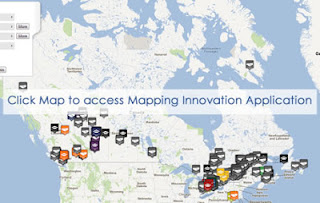
At the P3RD panel we also launched the P3RD site and the mapping innovation application we have developed to assist firms in finding an academic innovation provider. Under the tagline of Putting the S&T in Start Up, the P3RD site lets firms  indicate where they are located, what kind of innovation service they are looking for, and what industry they are from. They are then taken to a map which displays providers, partners and past projects. These past projects are an online resume of past work a provider has done, giving firms an idea of the kind of projects the college, polytechnics or university has done before. We are working with Tenet Computer Group on the technology, specifically their GreenRack cloud service, with plans to further leverage their Augmundo augmented reality technology. Read more about Tenet's leading innovative technology here.


We built this as a marketing vehicle for George Brown College, but have included the ability to add any innovation provider as a way to promote the idea of a concierge service. Think of it as LavaLife for creating public-private R&D partnerships. As I mentioned earlier this year, place matters to productivity. We need to encourage innovation in firms and enable these firms to find a provider of choice, be this down the street or across the country. The P3RD application enables this. 

At the conference we demonstrated the map, including an easy to use tablet interface for adding people. Minister of State for Science and Technology the Honourable Gary Goodyear stopped by to review the P3RD Mapping Innovation application, and to learn how this can aid industry in finding an innovation service provider.
Minister of State for Science and Technology the Honourable Gary Goodyear reviews P3RD Mapping Innovation
We will continue to work on refining the P3RD application with our partners. Check back as we continue to develop the site in partnership with others.

The P3RD panelists discussed how enabling technology innovation is relatively straight forward. What is needed most by firms is business expertise. This was reflected in an excellent panel I attended on social innovation convened by SSHRC president Chad Gaffield.  The social sciences and humanities are key to fostering what Dr Gaffield calls people centred innovation. Specialists in human thought and behaviour are key to enabling the innovation economy. The panel discussed concepts related to public-private partnerships, including not for profits, that are working together to bridge academic and industry sectors. Gaffield spoke about promoting "cultures of innovation" and panelists talked about how building partnerships involves having difficult conversations to link academics with firms when the latter needs to understand how these will help them earn money. Pam Laughland of the Network for Business Sustainability (a SSHRC funded organization that and has since raised $2M in investment) works to connect research and practice to convene and shape and transform ideas to make them usable by both audiences: businesses and academics. She spoke about the need to make partners part of the problem so that there is upstream affective investment in the issues under development, particularly regarding embedding sustainability in corporate culture. This involves converting outcomes into economic language as way to translate value so that industry sees themselves as part of the picture. This is a necessary instrumentality that translates to students, who learn about how their skills translate into innovation no matter the sector they work in (private, public or not for profit). As panelist Susanne Lajoie of McGill University put it, we need to teach the skills for 21st century education. Innovation requires ability to learn in new contexts, problem solving, communication, and ability to self regulate and be self directed. These are the skills of innovation literacy.

I attended many great sessions at the Innovation Partnerships 2012 conference, and I encourage all to check out the files online, and to attend next year's event.

03 December 2012

P3RD: New online service connects industry innovators with applied research service providers

A new web service designed to give firms an easy way to find innovation service providers in Canada launches today at the ACCT Canada conference INNOVATION 2012 – Connecting R & D and Commercialization.

Public+Private Partnerships for R&D: Putting the S&T in Start Up: p3rd.ca

On the crowded highway of research, development and innovation, Public+Private Partnerships for R&D (P3RD) gives industry a unique avenue for accessing capital, talent, facilities and markets supported through industry-academic applied research programs.

We focus on speed to market and connecting innovators to R&D resources.

P3RD is your entry into Canada's applied research ecosystem. Available at p3rd.ca, it is a free online resource for industry to find an innovation support provider in community & clinical organizations, and government & academic institutes in Canada. We encourage P3RD: Public+Private Partnerships for Research and Development. We enable industry to find an innovation support provider, learn about projects and capacity, and find out more about industry-academic partnership opportunities across Canada.

It’s easy to use: Firms can indicate where they are located (using either a postal code or city name), indicate what kind of innovation service they are looking for, and what industry they are from. They are then taken to the map which displays providers, partners and past projects.

The map shows innovation support providers who are open for business innovation.

The P3RD  application allows small and medium enterprises (SMEs) to better understand how to get involved with innovation providers: Canada’s polytechnics, colleges and universities, government research labs, and other innovation intermediaries.


12 April 2012

P3RD: Public Private Partnerships in Research and Development

The Globe and Mail's James Bradshaw yesterday put out a piece on Public Private Partnerships in Research and Development, or P3RDIBM teams with Ontario universities as part of federal innovation push heralds a good development in linking public and private sector R&D, as per my earlier comments on the recent budget. Canada needs to foster more of this. The fear that the shorter time horizons of industry R&D will deleteriously affect academic research is a red herring.

The privileging of basic research over applied research in Canada - of the theoretical over the practical or commercialization aspects of R&D - can be read as a symptom of our collective historical identity as "hewers of wood and drawers of water". Basic research sans commercialization is just one more example of how Canada exports raw commodities (ideas) without adding value (commercialization of these ideas). To move past raw commodity exports and adding value through product design is key to Canada's future productivity, and P3RD - which the recent budget explicitly promotes - is a positive path to follow in this regard.

Of course we must always be careful to ensure that academic freedom is protected - this is s staple of the academic enterprise. But Canadians in general must become more amenable to commercialization if we are to fix our long ailing productivity and innovation problems. Jim Balsillie's op-ed on this topic is interesting, and the story of the York-CIGI experience is instructive. A balance must be sought in the exploration of P3RD, particularly when Canada, even though we rank among the highest HERD spenders, does not have the GDP to support R&D in any and all disciplines. That is, we need to prioritize and play to our strengths.

Playing to our strengths means focusing our public R&D on the production of ideas and talent that can then be taken up by industry. A report out today by the Centre for the Study of Living Standards points out what Polytechnics CEO Nobina Robinson has said: companies commercialize; people innovate. As the Globe's review puts it, Competition needed to drive innovation, report says. The report is out today, and looks to be required reading on the topic of public-private partnerships in R&D.

26 November 2012

P3RD and Mapping Innovation in Canada

Last week I attended a couple of interesting talks that provided good inputs to our ongoing discussion about innovation in Canada. The first, by the Honourable Jim Flaherty, Minister of Finance, spoke at the Toronto Board of Trade. In his address, Minister Flaherty outlined some of the government's priorities going into the next election. Budget consultations are set to start this week, and Minister Flaherty offered a reasoned approach to where the government sees potential for reducing debt and fostering growth. He also mentioned kick starting the venture capital fund, to be led by the private sector (an excellent example of public-private partnerships for R&D: P3RD), that was announced in the last budget. Key to the government is encouraging economic growth through investments in infrastructure, skills training, R&D, and innovation.

The second event was Rob MacIsaac, President of Mohawk College & Chair of Committee of Presidents, Colleges Ontario, who spoke at a Canadian Club luncheon on "Unleashing the Potential of Ontario’s Colleges." MacIsaac picked up themes raised by Minister Flaherty, notably the links between skills training, R&D and innovation. He rightfully admonished the Ontario educational system for not working better as a system - a point raised during the Globe and Mail`s Our Time to Lead focus on education. Ontario needs to do more to realize the value of all educational inputs, and to retool our colleges, polytechnics and universities into a true system that effectively responds to and leads the province in terms of knowledge, labour and research production.

These themes are being raised at Colleges Ontario's annual Higher Education Summit, which offers an excellent array of speakers delving into these issues. Highlights of today's schedule include the future of manufacturing (set for disruption by the emergence of low cost 3D printers, or example, and the Maker Movement), and a panel on the future of post secondary education. 

The links between skills training, innovation and R&D represent a key front in our attempts to foster greater innovation across the economy. We explore these in our recent Toronto Next: Return on Innovation study, which shows there is still a lot of work to do in ensuring firms understand how innovation inputs lead to productivity outputs. Key for polytechnics and colleges is the development of innovation literacy in our graduates, and the promotion of P3RD. Those interested in innovation literacy and skills will be interested in this article on "Must-Have Job Skills in 2013", which shows strong parallels between what we discerned in our Toronto Next study.

And on the topic of P3RD, we will be launching a new industry web service that is designed to link the private and public sectors for R&D at the ACCT Canada conference next week. INNOVATION 2012 – Connecting R & D and Commercialization, being held 2-3 December in Ottawa, promises some excellent discussion on this and many other topics. It is not to be missed. On Monday I am convening a panel to discuss how best to link our public and private sectors for improved research and development. We will feature our mapping innovation app, which enable industry to find a public innovation support provider through an easy to use web application. Stay tuned for more details.

14 June 2012

Drawers of ideas and the privilege of the a priori

The Public Policy Forum today hosted a Leadership Roundtable on Canada's Global Science, Technology and Innovation Priorities, sponsored by DFAIT, which I was fortunate to attend. The discussion was excellent and focused on how Canada can better position itself internationally to enable soft landings - both outbound and in coming - for Canadian business to realize international markets as well as to link international businesses to Canadian contexts, linking to our world-leading S&T capacity. This capacity is reflected in our leading university research facilities, our college and  polytechnic applied research capacity, and the conjoint post-secondary training ground that makes us the world leader in producing highly qualified and skilled personnel (i.e. graduates) for the innovation economy.

Greater integration of our capabilities as a country will enable us to better sell Canada as an investment destination. This is the notion of complementarity and the need to better connect the academic enterprise with industry. We can call this P3RD - the public+private partnership model for R&D. In my last post on this, P3RD: Public Private Partnerships in Research and Development, I outlined the notion of what in my title today I refer to as the privilege of the a priori:
the privileging of basic research over applied research in Canada - of the theoretical over the practical or commercialization aspects of R&D - can be read as a symptom of our collective historical identity as "hewers of wood and drawers of water". Basic research sans commercialization is just one more example of how Canada exports raw commodities (ideas) without adding value (commercialization of these ideas). To move past raw commodity exports and adding value through product design is key to Canada's future productivity, and P3RD - which the recent budget explicitly promotes - is a positive path to follow in this regard.
In this sense Canada is also a drawer of ideas - we come up with good ideas but leave it to others to commercialize. Ideas are just another basic resource that we draw from the land and export without adding value.

[Aside]I am reminded of the Roman poet Horace who, among other  things, said that the poet should put a poem away in a drawer for nine years before bringing it back to see if it is still good. Perhaps we have been too focused on the idea of putting things away (in publications) - drawing ideas, putting them away in drawers.You get the idea. Another thing Horace said is instructive to our discussion about instrumentality: "Mix pleasure and profit, and you are safe." This relates well to the need to mix the academic and industry communities - where applicable - for Canadian productivity and innovation capacity. [/Aside]

The timing of this roundtable was excellent, particularly given the OECD's release yesterday of Canada's country report. The report says that "Canada needs to boost innovation and human capital to sustain living standards," and offers more fodder to the need for Canada to increase our innovation quotient. The Economic Survey of Canada 2012 makes many good points relating to Canada's innovation capacity and economic growth, including the advice that "Greater integration of technical, business, communications and industry training within tertiary programmes could contribute to innovation and improving graduate skills." This integration exemplifies the notion of people centred innovation, and is what George Brown College and other colleges and polytechnics are doing with regards to the integration of applied research in course curricula. This leads to students acquiring innovation literacy skills that are our hedge against future innovation capacity and potential for the economy. The OECD's Canada report and the idea of better integration of these components coincides with the recent launch of the OECD Skills Strategy. This is a good resource for anyone with an interest in innovation.

All told, the roundtable ended on a very optimistic note. Canada is in a much better place now than it was five years ago with respect to the capacity we have to leverage our basic and applied R&D capacity. We are much better now at linking with industry for common goals. And we have a much more refined sense of the innovation ecosystem and the complementary roles universities, colleges and industry play in improving Canada's innovation and productivity.

02 December 2013

NRC launches concierge service

The Honourable Greg Rickford, Minister of State for Science and Technology, today announced the launch of the much anticipated National Research Council's concierge service. The concierge service is a one stop shop approach to enabling firms to access government programs, and was a key recommendation of the Jenkins Panel. As the NRC completes its transformation into a Research Technology Organization, elements such as the credit note voucher (launched in Budget 2013) and the concierge service will go a long way toward enabling firms to innovate by accessing a single point of contact for referrals and "warm handoffs" among partners who act as innovation intermediaries.

Our common goal is enabling firms to access support for innovation, and a service such as the NRC will deliver will add significantly to our collective ability to marshal the right support, at the right time. We have been working on a similar portal into the college applied research system - the P3RD site. Public-Private Partnerships for R&D are imperative to releasing the untapped potential latent in our polytechnic and college applied research facilities across the country. Linking our world leading scientists, our polytechnic and college applied research capacity, and firms requiring innovation support will boost overall productivity. P3RD provides a map based interface that connects firms by geography, industry sector, and assistance required. Matching services like P3RD will plug into the concierge service, giving all innovation system agents access to information about the capacity that exists to serve the needs of firms.

The concierge service is a very timely addition to the innovation system in Canada. Minister Rickford spoke at the recent Polytechnics Canada Student Applied Research Showcase, where he reinforced the value of connecting firms with the applied research services we offer. As Minister Rickford put it: "Colleges also play a leading role in performing applied research that leads to economic growth and high-quality jobs. Applied research equips students with the positive work experience and entrepreneurial skills needed in today’s knowledge economy. Small businesses that partner with colleges are often the primary drivers of the economy in their communities, bringing more innovative products to market faster."

By linking firms with the talent, technology and networks we help these firms innovate, while enabling students to acquire innovation literacy. We look forward to working with our colleagues at the NRC as the concierge system rolls out, and ensuring firms can get the kinds of supports needed to boost Canadian innovation and productivity.


21 February 2013

The future of innovation is bright: Business Innovation Summit recap

The Conference Board of Canada convened the Business Innovation Summit these past two days, which featured a lot of great discussion on how Canada can step up its game in terms of encouraging firms to invest in productivity and innovation. The Honourable Gary Goodyear, Minister of State for Science and Technology and the Federal Economic Development Agency of Ontario (FEDDEV) opened the conference with a keynote address that focused on skills development and encouraging students from K-12 through to college and university to embrace innovation in their skills and entrepreneurship. This was an important theme of the conference.

Doug Watt and Dan Munro of the Conference Board picked up the theme of skills with an overview of their updated Innovation Skills Profile and the newly created Commercialization Skills Profile. These are important tools that can aid educators and firms alike to assess and develop the innovation and commercialization skills people need in order to enhance and engage in innovation and commercialization. A couple of years ago I put together a study to measure innovation literacy in students engaged in applied research; Doug and Dan and the Conference Board were partners in this. Our plan was to use the Conference Board's General Innovation Skills Aptitude Test (GISAT) to assess the innovation skills in order to start unpacking outcomes associated with how we foster innovation literacy in our programs and applied research with industry. I am pleased to say that we will relaunch this effort. Part of George Brown College's commitment to Enabling the innovation economy in our Strategy 2020 Balanced Score Card is to create an impact measure that will enable us to asses the downstream effects of our programs and applied research projects. Our Innovation Advisory Board has been very instrumental in helping to move this work along, and we are ready to relaunch the Measuring Innovation Literacy study. Stay tuned for more details.

Another notable element of the conference was a talk about Deloitte's study on The Future of Productivity. This contains prescriptions for industry, government and academia. For the latter, this includes the need to "Align curricula with business and industrial needs for scientists, engineers and leaders" and "Develop, protect and exploit intellectual properties developed at the post-secondary level." Colleges and polytechnics, as well as professional programs in universities, are well attuned to the first point. Canada does a deplorable job on the second. As I've said before, ideas emerging from Canadian basic research seem to be just another raw resource we extract and give away without adding value (i.e. commercializing). It's time to rethink the ways in which we promote basic research and university tenure to foster greater value-added R&D.

Latent in the first point about aligning business needs to curricula is the idea of public-private partnerships for R&D, or what I call P3RD. Taken together - fostering innovation skills throughout the education systems, linking industry needs to curricula, and taking an instrumental approach to aligning R&D outputs and input - are all part of taking a managed approach to innovation and outcomes. On the topic of P3RD, NSERC president Suzanne Fortier announced the results of their mid-term evaluation of their partnerships program at the Summit. The news is good: Sixty Percent Increase in Businesses Doing Partnered Research and Innovation with Universities and Colleges, an increase that can be strongly attributed to the success of the College and Community Innovation Program that funds colleges and polytechnics to work with firms on applied research.

The future of innovation is bright when you see the kinds of outcomes associated with applied research we conduct with industry partners. I convened a session at the Summit on How Colleges Support Business Innovation and Commercialization, featuring Carlos Paz-Soldan, president of Tenet Computer Group and a GBC Research partner, and John-Allan Ellingson, a student in our Mechanical Engineering program. Carlos, who also chairs our Innovation Advisory Board, told the audience about Tenet's Pandemic Planning Toolkit for Mobile Devices product that GBC Research worked on, and outlined Tenet's new Green Rack Service (coming soon to a conference near you) that we are now supporting through applied research engagement. Carlos talked about the value of engaging in collaborative applied research as it enabled him to extend his own R&D and commercialization capacity while being a conduit for recruitment of full time and co-op students.

A real highlight for me was our student, John-Allan Ellingson, who spoke about applied research work he is doing on industry partner SOS Customer Service's crane project. The project is being led by Professor Jamie McIntrye of the Centre for Construction and Engineering Technologies, who is also the innovation lead for our Advanced Prototyping Lab. SOS Customer Service Inc. (SOS) is an Ontario SME that specializes in the design, development, sales and services of cranes, hoists, process automation and handling devices. SOS is collaborating with the George Brown College and Jamie McIntryre’s group to design, prototype and test a novel, lightweight and portable crane to lift windows into place for installation during construction of low-rise commercial and residential buildings. SOS has developed an innovative and simple design concept for the prototype. The new crane is expected to have significant advantages over technologies and approaches and has potential to significantly impact the return on investment (ROI) at building worksites. John-Allan is part of the team that is working with SOS to develop, prototype, test and commercialize their innovative design.

John-Allan spoke about the kinds of skills he is learning as a result of this applied research project, and how the project is giving him cumulative experience encompassing not just the engineering skills, but also design skills. This is an important point, as it relates to the need for both STEM and nonSTEM skills, and that innovation literacy and adoptation - the ability to adopt and adapt - demand a combined skillset. Chad Gaffield, President of SSHRC, put this well during another session on partnerships when he said that firms have the opportunity to partner with the whole campus when we engage all relevant fields, from the natural sciences and engineering to the social sciences and humanities. Not every faculty member in every department at universities or colleges wants to or is interested in engaging with firms on innovation challenges. But for those that do there is a lot of value: for the firms, the faculty members, and most of all, the students who, like John-Allan, demonstrate the kinds of innovation skills that will drive Canada's future productivity. Discussion on these important issues such as was enabled by the Business Innovation Summit gives me optimism about our future.

15 August 2012

Polytechnics Canada Pre-Budget 2013 Recommendations

Polytechnics Canada has put forward their Pre-Budget 2013 Recommendations, available on their website. Notable is the continued support of college applied research and the further development of apprenticeship. As I've noted before, the skilled trades are the knowledge workers of the innovation economy, providing a much needed link between our capacity to think up new ideas and to put them into practice - the connection between thinking, making and innovation is a cornerstone of a healthy economy.

The Polytechnics Canada submission has three key recommendations for improving the public-private partnership model of R&D (what we call P3RD):

Through re-allocating funds to industrial applied research, the federal government can help more companies overcome the “death valley” of commercialization and become competitive. Three specific actions are to:
  • Implement a national commercialization voucher program that allows Canadian firms to choose the late-stage commercialization support they need, as recommended by the OECD study;
  • Increase funds for the College Community Innovation Program to $50 million per year to address unmet demand from firms for innovation solutions;
  • Expand the eligibility of NSERC’s Industrial Undergraduate Student Research Awards program to include college undergraduate students.
Fostering improved industry-academic collaborations through a P3RD model is an essential component of helping Canada improve its innovation and productivity. Reforming our approach to education along the way by providing a more modern approach to credential laddering and articulation will in turn foster greater education and training capacity throughout the economy. This can be understood as a productivity issue on the education system, and while Canada regulates education provincially, we have a unique opportunity to leverage federalism to enable greater mobility of highly qualified and skilled personnel across the life span. Life-long and life-wide learning will thus enable greater diffusion of innovation.

07 March 2012

Companies commercialize; People innovate

The upcoming Federal Budget promises to continue the evolution of the Canadian R&D system, if Prime Minister Harper's comments in the press about getting value for money are any indication. Minister of State for Science and Technology Gary Goodyear says in today's Globe that the changes that are coming won't be simple fixes.

On Monday I was on BNN's the Close speaking with host Michael Hainsworth about the SR&ED tax credit, picking up the themes from this week's release of the C-Suite Survey.

Notwithstanding a couple of "speakos" (verbal typos; notably on the 99% of basic research in universities versus 1% - not a dollar - on college applied research), it was a good discussion of the need to simplify the SR&ED system. As I note in the segment, Canada enjoys some of the most generous tax credits for R&D in the world. We need to streamline the system and focus on people. Focusing incentives on more upstream supports like an industry innovation voucher system (such as that in Alberta) will help small companies have better access to applied research supports offered by colleges and polytechnics. The Canadian innovation system needs a single-window approach (something recommended by Drummond and the Jenkins Panel) that offers a streamlined access point to industry innovation supports in the public sector. I've earlier called this a P3RD system: the explicit linking of public and private sector R&D. Most importantly we need to focus on the talent stream.

Companies come to colleges and polytechnics to access three critical components in their commercialization efforts:

  1. Access to equipment and space
  2. Access to funding and grants to support their own R&D spending (P3RD)
  3. Access to talent, both our faculty who are industry experts and our students.
It is the access to students that is the most important aspect of college and polytechnic applied research. Students gain crucial innovation literacy skills while learning to apply their technical skills to industrial contexts. As I note in my last post, the people-centred innovation skills are the essential wrapper around the technical skills gained at all levels. 

Take the example of Clear Blue Technologies, a GBC Research industry partner who is working at our Business Accelerator and Entrepreneurship Centre for green building and green energy. Clear Blue Technologies has developed an off grid, dual power (wind and solar) street light, part of their focus on  intelligent cloud-controlled street lights and security systems. Having already hired one of our graduates, the Clear Blue team works alongside our faculty and students, as well as a Ryerson University doctoral student (an example of complementarity), which amplifies  the acquisition of innovation skills for all. This is the multiplier effect that leads to an approach focused on speed to market for industry while ensuring that the students at all levels acquire innovation skills.

Again, this is about a people-centred innovation, because companies commercialize; people innovate.


21 June 2012

P3RD - Public+Private Partnerships for Research and Development


On the crowded highway of research, development and innovation, Public+Private Partnerships for R&D (P3RD) gives industry a unique avenue for accessing capital, talent, facilities and markets through the college/polytechnic applied research programs. Our focus is on speed to market and engaging our students in industry innovation. 

06 March 2009

Applied Research: Innovation, Productivity and the R&D Continuum

The ACCC 2009 Applied Research Symposium: What does success look like? was held in Ottawa on 25-26 February, and featured interesting and informative presentations about the role of colleges in the R&D innovation chain. The conference focused mainly on some of the issues involved in establishing college applied research: building a research culture, intellectual property, metrics, and community-focused versus industry focused research. Walter Stewart, from the Toronto Region Research Alliance, gave the opening keynote, and challenged the audience to focus our efforts in applied research capacity development on how we can serve our mandate to students and industry. In so doing, we must not try to be all and do all, but rather focus our efforts according to our strengths. This fits well with the notion of complementarity.

My own talk - from which I took the title of this post - was intended to illustrate the role of Polytechnic applied research. My focus was on topics I have written about here, and the shared challenge we all have to work within our areas (geographic, specialization): complementarity.

Here are my speaking notes:

Innovation
  • Canada’s Innovation Capacity
  • 13th out of 17 countries (OECD)
  • “D” for innovation: “it’s been a D for decades”
    Conference Board of Canada, How Canada Performs: A Report Card on Canada

    Canada seems very good at inventing things, but not so good at capitalizing on inventions.
Productivity
  • Canada is second in OECD for HERD; 12th in BERD
    HERD: Higher Education Expenditures on R&D
    BERD: Business Expenditures on R&D
  • Firms are not making effective use of postsecondary applied R&D capabilities
    “We’ve gone too far in subsidizing R&D, and not far enough in subsidizing diffusion of innovation.” (Sharpe 2009)

    Our goal is to help firms make better use of applied R&D capabilities.
Role of the applied research office
  • We focus on Regional R&D Capacity and Innovation Transfer and
  • Complementarity in the R&D Continuum

    We are not trying to replicate what any of the university, government or industry research labs do. Rather, we do what they cannot do: fabrication of prototypes, for example.
Startup.edu
  • We are a startup, and we help startups
  • We offer “Last Mile” R&D services
  • The Stages of technology development provide a useful framework for how we fit into the R&D continuum
How we’re different
  • We respond to industry needs
  • We have industry governance through the GBC Research Innovation Advisory Board
  • The IAB is a multi-sectoral SME and entrepreneurial stakeholder group whose primary role is to provide a current and effective link between the Research and Innovation office at George Brown College and the key sectors it serves
Innovation Support Services
  • We offer innovation support services to sector partners, using a validate/simulate/adaption model to
  • Validate practicality and usability of new technologies/products/processes
  • Simulate impact of their use
  • Adapt those technologies for deployment under diverse conditions
  • Testing practicality and market/user/practice adoption and adaptation lets us focus on the implementation of innovation

    This is the Diffusion of Innovation
From discovery to design
  • Our Multidisciplinary Collaborative Problem Solving model mobilizes college disciplines in support of industry needs
  • The intentional application of applied research and innovation services to industry needs and contexts means we focus less on discovery, and more on the design of innovation - how to test the practicality of new products or services (adoption and adaptation)
  • Our model uses college verticals in a horizontal integration strategy
    This is a matrix for understanding our innovation intentionality:
    College disciplines are verticals of expertise. A project is a horizontal that accesses expertise as needed/required from each vertical.
  • Move from idea to invoice
Innovation Literacy
  • This is a cornerstone of what our students gain from participating in applied research projects: the ability to think creatively and apply problem-solving skills to diverse and intangible issues within industrial problems and contexts.
  • Innovation literacy is a transferable skill that enables our students to be flexible innovators in the workforce.
  • Our students are Highly Qualified and Skilled Personnel
    Innovation literacy is the creativity called for by Martin and Florida
Open Innovation
  • “…the use of purposive inflows and outflows of knowledge to accelerate internal innovation, and expand the markets for external use of innovation, respectively.” (Chesbrough)
  • All colleges, working together, can foster an open source approach to innovation and capacity building for improved social and economic productivity in Canada
Open Innovation Network
College and Community Innovation Program
  • The NSERC CCIP represents a significant investment and awareness of the importance of colleges in the innovation chain in Canada.
  • Relating back to HERD and BERD (see Productivity, above), the CCIP is a P3RD
    A Public Private Partnership R&D investment
  • This is a public R&D subsidy that is specifically designed to increase BERD commensurate with HERD

We must take this opportunity, and, in recognizing it as P3RD, deploy these funds strategically to foster social and economic productivity. We have an important role to play in the R&D continuum in Canada, and that role should also focus on how colleges can work together - like the Polytechnic Applied Research Cluster model - to ensure that this capacity can realize its potential and contribute meaningfully to improving Canada's innovation capabilities. Canada's college are key to improving community economic and social development.

My challenge to us all is to make this collaboration work, to find ways to work together in a complementary fashion. It is important to celebrate our successes, but it is even more important now to look ahead to the future and chart where we are going. This future-forward orientation will be the focus of a panel I will be convening for the ACCC Annual Conference.

11 May 2009

The Innovation Equation

The OCE Discovery 2009 is on now - drop by to see the GBC Research Labs' booth and learn more about the innovation equation:

Public-Private Partnerships + Research and Development = P3RD

Investing in industry-facing applied research and commercialization activities and fostering "open innovation" and complementarity across the R&D value chain will result in improved social and economic productivity in Canada.

26 March 2014

Toronto Region Board of Trade on a resilient regional economy

The Toronto Region Board of Trade hosted Roger Martin of the Institute for Competitiveness & Prosperity on Monday to speak to a new report they have released called Toward a Toronto Region Economic Strategy. The report follows on the important work on clusters TRBOT has been sponsoring over the past few years and the most recent Scorecard on Prosperity (2014), and features an in depth analysis of the sate of the Greater Toronto Area economy, the inputs that make it function, the clusters that dominate the socio-economic landscape, and what action is needed to spur growth. It is the call to action that are the main features here, as the Toronto Region is not performing well. As TRBOT CEO Carol Wilding and TRBOT Board Chair Beth Wilson state in their introduction, the report “leads to a framework for a regional economic strategy and examines where Toronto excels, faces challenges, and provides opportunities for consideration for the region not only to become more economically productive, but also to be a more livable and prosperous region.” In short, the story as it is is not that good. Toronto lags in many areas, and concerted action is needed to maximize the potential latent in the region.

It is good to see the report acknowledge the full spectrum of the post secondary landscape, from colleges, to polytechnics to universities, as being part of the Education and Knowledge Cluster. The other clusters – Financial Services (the single largest cluster by far), Information Technology, Processed Food, and Life Sciences – are all important drivers of the regional economy. Key here is finding ways for businesses to lead cluster development and refinement, and to spur industry to invest in the three pillars of economic development: new technology, training of employees, and R&D.

Certainly in the training and education aspects Toronto does well, with numerous leading universities, polytechnics and colleges in the Greater Toronto Area. On the R&D side, the report makes positive mention of the need to foster greater industry R&D spending, as well as increasing the capacity of education institutions to partner with firms on R&D activities. These kind of public-private partnerships for R&D (what I call P3RD) are important drivers not only of business innovation, but also of fostering broader innovation skills throughout the educational process, from undergraduate through to graduate.

The report calls for the creation of a higher education advocacy group for the Toronto area, building on the London, UK model, in support of the Education and Knowledge Cluster. This is a good i9dea, and builds on the increasing awareness of al PSE institutions in the region of the value of working together. More work is needed, and such an advocacy group will enable us to combine the best from each, recognize that each kind of institution – university, polytechnic, and college – all play important roles in supporting the entire range of workforce development. The same holds true for research, as both basic and applied research excellence is needed. This will foster greater academic productivity, as well as greater business innovation and productivity.

The report acknowledges the complementary role that colleges and polytechnics play in the education and R&D ecosystem. It also speaks about experiential learning, and the value this brings to all students from any educational context. This is a signal opportunity to invest in the teaching of innovation and entrepreneurship skills commensurate with fostering academic inventions and commercialization together with business innovation.

The Processed Food cluster represents a key area that I’ve been active in for the past couple of years, all in support of the TRBOT’s efforts to foster greater competitiveness and growth in this important sector of the economy. The Food Innovation Research Studio (FIRSt) is a key applied research centre of excellence at GBC, and the applied R&D we conduct with local firms combined with our leading educational programs makes us a key stakeholder in this area. There is good work going on here by many people; watch this space for updates in the future.


The report is a must read for anyone interested in the long-term health of the GTA. It has important data on what is working and why, and equally important information as to what actions are required to enable Toronto to realize its full potential. It is a highly credible and reliable source of information and insights that forms a key fulcrum of the TRBOT “Think Twice, Vote Once – Decision 2014: campaign. Kudos to the TRBOT, the Martin Prosperity Institute, and KPMG for producing this important work. It should be circulated – and read – widely.

25 April 2012

Research, development and international innovation exchange

An article today by the Globe's James Bradshaw on the mission by the Governor General and Canadian university presidents reflects the growth of Brazil and good efforts by Canada to connect with this growing and prosperous nation. Brazil's ambitious Science without Borders initiative will enable top Brazilian students to tap Canada's world leading research and education capacity. It is also an opportunity to develop close ties to Brazilian markets for Canadian companies and innovation. Linking R&D to international innovation through "soft landings" in Brazilian (and other international) markets is one way we can help Canadian entrepreneurs succeed in the global market. The soft landing here refers to working with Brazilian colleges and universities and their technology transfer institutions to connect to local conditions and find valuable conditions for innovations to reach Brazil's markets. The Brazilian mission heralds a very positive step forward for Canada's science and technology enterprise. Polytechnics Canada CEO Nobina Robinson is joining the Governor General on the mission to Barbados and Trinidad & Tobago.

And speaking of our S&T capacity, the Globe's print version has an excellent special supplement on research and Development. It includes strong messages from the granting councils and many university presidents on the need to connect our S&T enterprise to business innovation. Earlier this week Timothy Caulfield opined about the value of basic research, decrying any focus on the application of research. In so doing he demonstrates the long held bias held by many researchers toward applied research. As a result, he overlooks the importance of innovation and commercialization. Canada is near the top of the OECD in public sector research, but near the bottom for industry research--a differential that contributes to our productivity problem. Our goal must be to realize the gains basic science creates rather than simply giving these away for others to sell back to us. Basic and applied sciences are equally necessary and fully complementary endeavours.

The sooner we connect these two solitudes the better our country will be. The Brazilian mission shows that a strong and healthy S&T system includes solid connections to training talent for R&D and industry innovation, and connecting to business innovation downstream of scientific discovery. To not do this is to abrogate our responsibility to the future. It bears repeating:

The privileging of basic research over applied research in Canada - of the theoretical over the practical or commercialization aspects of R&D - can be read as a symptom of our collective historical identity as "hewers of wood and drawers of water". Basic research sans commercialization is just one more example of how Canada exports raw commodities (ideas) without adding value (commercialization of these ideas). To move past raw commodity exports and adding value through product design is key to Canada's future productivity, and P3RD - which the recent budget explicitly promotes - is a positive path to follow in this regard.

24 September 2010

Innovation needs a backbone

ORION's new CEO Darin Graham spoke to the Greater Toronto Marketing Alliance earlier this week on the topic "Innovation needs a backbone." Graham's talk was an excellent call to industry to invest in R&D, as well as for those of us in the public innovation support sector to work together in supporting industry innovation. ORION provides the necessary ICT capacity to enable collaboration in the public R&D sector, and opening this up to the private sector is a good example of what a P3RD (see "the innovation equation") innovation support system can be.

Graham reminded us that innovation does not inherently exist in the universities and colleges; rather, it is inherent in the people who go there - the students, faculty and our industry partners. He also reminded us that innovation in not invention. Innovation has outcomes in the realization of social and/or economic value. Fostering innovation is at once as easy as enabling serendipity and interprofessional collaborations, but as difficult as doing this in a world of competing values, cultures ("academic: publish or perish versus private: profit or perish") and priorities. To enable innovation we need transparency in terms of our interface among organizations (c.f. brokering R&D relationships) and in our approach to intellectual property. This form of open innovation will push productivity improvements through a complementary approach to enabling industry innovation through a robust innovation infrastructure, in this case the ICT products and services that are the interface to collaboration as well as the locus of R&D development itself.

And while we are on the topic of enabling innovation, here is a link to a recent article that reinforces the need to invest in education as a main driver for an innovative economy. This includes integrating immigrants into the work force and addressing the skills gap and skills shortages we face. Ensuring we have highly qualified and skilled people with innovation literacy across all economic sectors will help lift Canada's poor productivity performance.

06 September 2012

The two solitudes of Canada's competitiveness

A report out today showing that Canada has slipped again in international competitiveness ratings offers (again) sobering statistics on our need to get our innovation and prosperity house in order. A couple of things stand out for me in this report - the focus on education and the point made that "Switzerland’s scientific research institutions 'are among the world’s best, and the strong collaboration between its academic and business sectors, combined with high company spending on R&D, ensures that much of this research is translated into marketable products and processes.'”

As noted, Canada does not take advantage of our "well-educated workforce," primarily because we do not see education as a single entity. The bifurcation between college and university - as evidenced by recent press reports on the difference between college and university graduate salaries, for example - prevents us from realizing the true potential of an articulated education system. (Today's Letters to the Editor has an excellent rejoinder to this discussion from Colleges Ontario president Linda Franklin.) I've written about this before, and also about the fact that Canada is #1 in the OECD for post-secondary education attainment only when you include both college and university together (OECD Type A and Type B education).

On the issue of "strong collaboration between its academic and business sectors," this is a topic of great importance for Canada. We need to realize that industry-academic partnerships are a positive path toward greater innovation capacity. Other countries understand this better than we do; Canada would be wise to embrace what I have elsewhere called P3RD: Public+Private Partnerships for Research and Development. We eschew strong connections in education and research with industry at our innovation peril.

And so there are two two solitudes: the two solitudes of education (college and university) that are treated as a parallelism in Canada; and the two solitudes of industry and academic R&D and production.

On  the former, let's invest the debate with what might be possible with a nationally articulated education system (timely given that Ontario is in the midst of a large scale educational transformation consultation). On the latter, let's take seriously the outputs of the Jenkins panel report and the upcoming release of the Council of Canadian Academies' report on The State of Science and Technology in Canada. And on this note, you can hear a podcast with Expert Panel Chair Dr. Eliot Phillipson discussing this important work on the CCA site.

03 March 2010

Micro-Financing the Innovation Ecosystem

College/polytechnic applied research offers complementary R&D capacity to the Canadian innovation system. Funding programs such as the NSERC College and Community Innovation Program and the Colleges Ontario Network for Industry Innovation (CONII) are part of a public+private partnership funding model (P3RD) that support the innovation ecosystem.

We see our role as not only supporting SME innovation capacity, but also in preparing industry partners to move along the innovation chain. An ancillary effect of our applied R&D efforts is the graduation of our SME partners into more developed funding programs such as the Ontario Centres of Excellence.

A majority of our work involves Proof of Principle projects with short time horizons that cost $10-$20K. A member of the GBC Research Innovation Advisory Board  put it succinctly: We engage in micro-financing of applied R&D for Canadian SMEs.

27 March 2009

Ontario budget supports applied research

Yesterday's budget by the Ontario government includes $10M for the continuation (for three years) of CONII. This is in addition to the tax cuts for businesses and infrastructure spending to match federal money form Budget 2009. Combined, this represents a favourable environment for industry-focused applied research and other avenues for "Accelerating Innovation." Funding for programs such as CONII are excellent vehicles for what I have termed P3RD - the Public Private Partnership R&D investment required for increasing productivity. Other highlights of the budget include the infrastructure spending for colleges and universities, and funding for skills training.

25 January 2013

Changes to SR&ED welcome, but not enough

The Canada Revenue Agency announced changes to the Scientific Research and Experimental Development (SR&ED) program. As the Globe reports in Ottawa moves to streamline R&D tax-credit program, this is part of the effort to improve the system following last year's Budget. The changes should be welcome news fro firms investing in R&D, and for tax payers who want to see more accountability in the program. We also need to see more business investment in R&D. These changes however do not go far enough. Part of the issue with the SR&ED program is that it focuses too much on the SR and not enough on the ED.

The OECD's Frascati Manual defines three forms of research: basic research, applied research and experimental development. Here is the exact definition from the Frascati Manual:

Basic research is experimental or theoretical work undertaken primarily to acquire new knowledge of the underlying foundation of phenomena and observable facts, without any particular application or use in view. Applied research is also original investigation undertaken in order to acquire new knowledge. It is, however, directed primarily towards a specific practical aim or objective. Experimental development is systematic work, drawing on existing knowledge gained from research and/or practical experience, which is directed to producing new materials, products or devices, to installing new processes, systems and services, or to improving substantially those already produced or installed. (2.1.64)
Here is how CRA defines the three under What work qualifies for SR&ED tax incentives?:

“scientific research and experimental development” means systematic investigation or search that is carried out in a field of science or technology by means of experiment or analysis and that is
(a) basic research, namely, work undertaken for the advancement of scientific knowledge without a specific practical application in view,
(b) applied research, namely, work undertaken for the advancement of scientific knowledge with a specific practical application in view, or
(c) experimental development, namely, work undertaken for the purpose of achieving technological advancement for the purpose of creating new, or improving existing, materials, devices, products or processes, including incremental improvements thereto,
and, in applying this definition in respect of a taxpayer, includes
(d) work undertaken by or on behalf of the taxpayer with respect to engineering, design, operations research, mathematical analysis, computer programming, data collection, testing or psychological research, where the work is commensurate with the needs, and directly in support, of work described in paragraph (a), (b), or (c) that is undertaken in Canada by or on behalf of the taxpayer,
but does not include work with respect to
(e) market research or sales promotion,
(f) quality control or routine testing of materials, devices, products or processes,
(g) research in the social sciences or the humanities,
(h) prospecting, exploring or drilling for, or producing, minerals, petroleum or natural gas,
(i) the commercial production of a new or improved material, device or product or the commercial use of a new or improved process,
(j) style changes, or
(k) routine data collection;

SR&ED does not consider key components outlined in Frascati: things like installing and improving for example - that is, putting into practice incremental innovation. In short, SR&ED is biased toward basic research and ignores the very important aspects of actually getting R&D into markets. Now, one may say we have to draw the line somewhere because we don't want just anything to be eligible as this would be prohibitively expensive. Fair comment. But Canada is a country with  one of the highest per capita spends on HERD, has world leading basic research, yet a lackluster BERD where firms lag our international counterparts. This is compounded by a need to focus our inventions on innovation - on how we get innovations to market. Without supports for actual market entry, we are doomed to repeat the failures of the past: giving away our inventions for other countries to commercialize for us and, ultimately, to sell back to us. It`s time we moved incentives to where they are needed: upstream, as in the form of innovation vouchers to let the market decide where to access P3RD support, and supports for activities that actually relate to the market, understanding customers, and incremental innovation. We have a 19th Century view of research, when we need a 21st Century approach to innovation. It`s time we focused on "adoptation" and market entry for our research, and on commercialization inventions. That would be money well spent.